

The Sensitive Young Meme
Caspar David Friedrich at the Met

Welcome to my new Substack :) I am beginning by posting three articles that I have previously published in Real Clear Books. This is the third of three. New writing coming soon!
***
One of the most beautiful paintings in the Caspar David Friedrich show The Soul of Nature, on view at the Metropolitan Museum of Art through May 11, shows a roiling ocean crashing against a rocky coast by moonlight. The tiny figure of a monk stares out into the void, alone. The juxtaposition of terror and poetry brings to mind a line from the memoirs of François-René, vicomte de Chateaubriand, a contemporary of Friedrich’s and a fellow Romantic:

“Not a day passes when, reflecting on what I have been, I do not see in my mind’s eye the rock where I was born, the room where my mother inflicted life on me, the raging tempest that was my first lullaby…Heaven itself seemed so to arrange these circumstances to place in sight of my cradle an emblem of my destinies.”
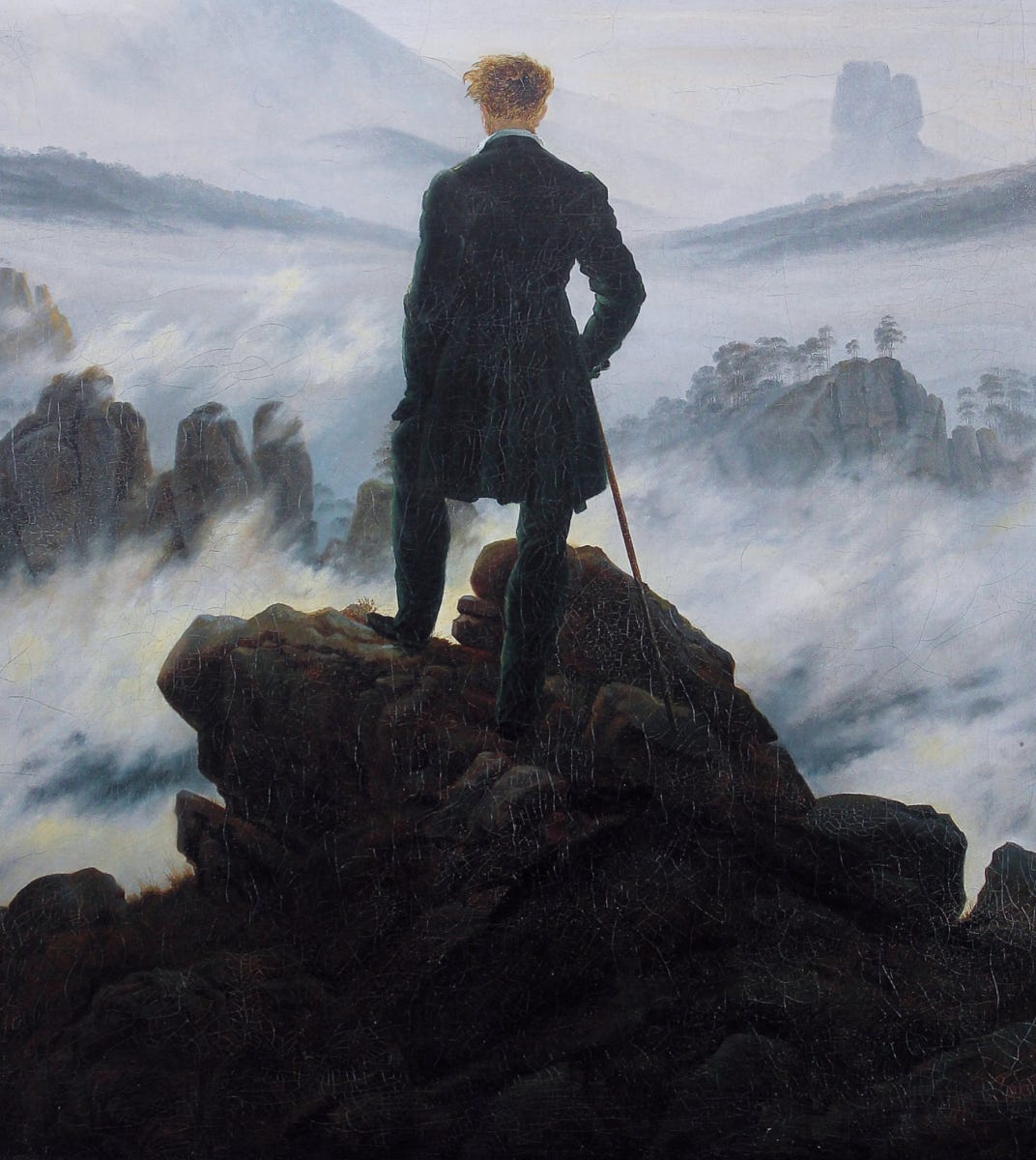
Caspar David Friedrich’s life spanned an era of revolutionary quests for political liberty and a reaction which sought an internal, spiritual liberty away from the violence of politics. He was born in 1774 on the Baltic coast of Swedish Pomerania (now Germany), and he spent most of his life in Dresden, where he died in 1840. Friedrich rose to prominence as an artist in the first decade of the 19th century with large-scale watercolor and pencil drawings of landscapes imbued with a mystical spirituality. He was a perfect exemplar of the original generation of sensitive young men.
The year Friedrich was born, Goethe published The Sorrows of Young Werther, a proto-Romantic novel about a painfully sensitive young man who, following a sketching holiday in nature, is so overcome with unrequited love that he commits suicide. The success of the book was so immense that it led to international "Werther Fever," which caused young men to dress like the hero and even, reportedly, to commit copycat suicides.